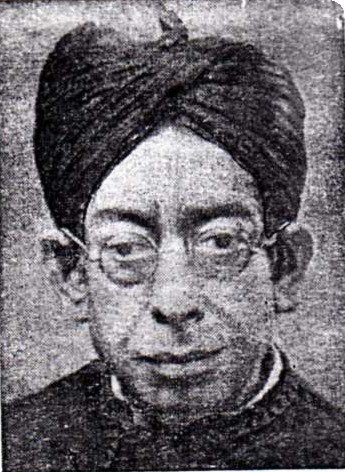
Surendranath Dasgupta (18 October 1887 – 18 December 1952) was an Indian scholar of Sanskrit and Indian philosophy.
Family and education
Surendranath Dasgupta was born to a Vaidya family in Kushtia, Bengal (now in Bangladesh), on Sunday, 18 October 1885, corresponding to Dashami Shukla (i.e., the tenth day) of the month of Āśvin and coinciding with the festivals of Dussehra and Durga Visarjan. His ancestral home was in the village Goila in Barisal District. He studied at Ripon College in Calcutta and graduated with honours in Sanskrit. Later, in 1908, he received his master's degree from Sanskrit College, Calcutta. He got a second master's degree in Western philosophy in 1910 from the University of Calcutta.
Prof. Dasgupta married Himani Devi, the younger sister of Himanshu Rai, India's pioneer film director and founder of the Bombay Talkies movie studios. They had six children together: three daughters, Maitreyi Devi (Sen) (1914-1989), Chitrita Devi (Gupta) (1919- 2006) – both of whom became famous writers – and Sumitra Majumdar; and three sons, Subhayu Dasgupta, Prof.Sugata Dasgupta, founder of Jai Prakash Institute of Social Change,and Prof. Subhachari Dasgupta, all of whom left behind works valuable to nation-building. Sumitra Majumdar, the youngest and last surviving child, died in Goa in September 2008. One of his granddaughters (daughter of Chitrita Devi) Prof. Lali Chatterjee, is a noted astro physicist based in United States.
Dasgupta earned the Griffith Prize in 1916 and his doctorate in Indian philosophy in 1920. Maharaja Sir Manindra Chandra Nandy now urged him to go to Europe to study European philosophy at its sources, and generously bore all the expenses of his research tour (1920–22). Dasgupta went to England and distinguished himself at Cambridge as a research student in philosophy under Dr. J. M. E. McTaggart. During this time the Cambridge University Press published the first volume of the History of Indian Philosophy (1921). He was also appointed lecturer at Cambridge and nominated to represent Cambridge University at the International Congress of Philosophy in Paris.