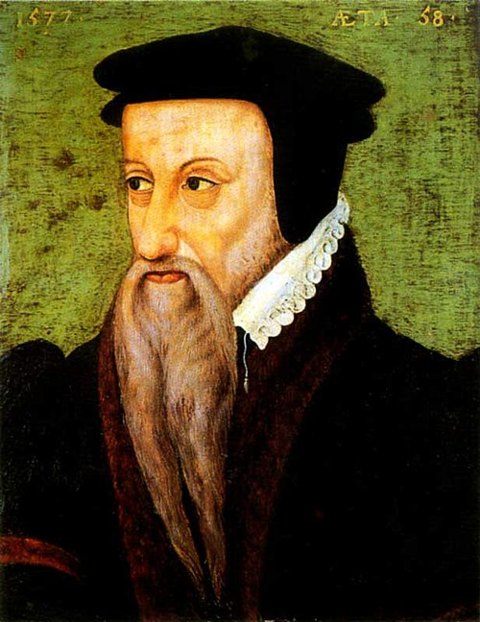
Theodore Beza (Latin: Theodorus Beza; French: Théodore de Bèze or de Besze; 24 June 1519 – 13 October 1605) was a French Calvinist Protestant theologian, reformer and scholar who played an important role in the Protestant Reformation. He was a disciple of John Calvin and lived most of his life in Geneva. Beza succeeded Calvin as the spiritual leader of the Republic of Geneva.
Early life
Theodore Beza was born on 24 June 1519 in Vézelay, in the province of Burgundy, France. His father, Pierre de Bèze, bailiff of Vézelay, descended from a Burgundian noble family; his mother, Marie Bourdelot, was known for her generosity. Beza's father had two brothers; Nicolas, who was member of the parlement of Paris, and Claude, who was abbot of the Cistercian monastery of Froimont in the diocese of Beauvais. Nicolas, who was unmarried, during a visit to Vézelay was so pleased with Theodore that, with the permission of his parents, he took him to Paris to educate him there.
From Paris, Theodore was sent to Orléans in December 1528 to receive instruction from the German humanist Melchior Wolmar. He was received into Wolmar's house, and the day on which this took place was afterward celebrated as a second birthday. Beza soon followed his teacher to Bourges, where the latter was called by Duchess Margaret of Angoulême, sister of King Francis I. At the time, Bourges was the focus of the Reformation movement in France. In 1534, after Francis I issued his edict against ecclesiastical innovations, Wolmar returned to Germany. Beza, in accordance with the wish of his father, went back to Orléans and studied law from 1535 to 1539. The pursuit of law had little attraction for him; he enjoyed more the reading of the ancient classics, especially Ovid, Catullus, and Tibullus.