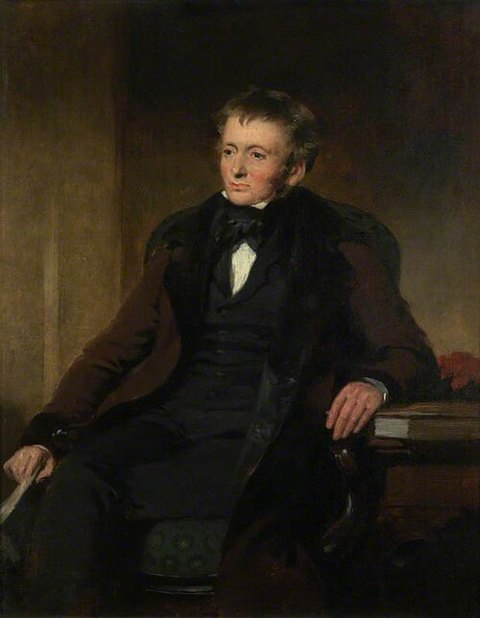
Thomas Penson De Quincey (né Thomas Penson Quincey; 15 August 1785 – 8 December 1859) was an English writer, essayist, and literary critic, best known for his Confessions of an English Opium-Eater (1821). Many scholars suggest that in publishing this work De Quincey inaugurated the tradition of addiction literature in the Western world.
Child and student
Thomas Penson Quincey was born at 86 Cross Street, Manchester, Lancashire. His father was a successful merchant with an interest in literature. Soon after Thomas's birth, the family moved to The Farm and then later to Greenheys, a larger country house in Chorlton-on-Medlock near Manchester. In 1796, three years after the death of his father, Thomas Quincey, his mother – the erstwhile Elizabeth Penson – took the name De Quincey. That same year, his mother moved to Bath and enrolled him at King Edward's School. He was a weak and sickly child. His youth was spent in solitude, and when his elder brother, William, came home, he wrought havoc in the quiet surroundings. De Quincey's mother was a woman of strong character and intelligence but seems to have inspired more awe than affection in her children. She brought them up strictly, taking De Quincey out of school after three years because she was afraid he would become big-headed, and sending him to an inferior school at Wingfield, Wiltshire.
Around this time, in 1799, De Quincey first read Lyrical Ballads by William Wordsworth and Coleridge. In 1800, De Quincey, aged 15, was ready for the University of Oxford; his scholarship was far in advance of his years. "That boy could harangue an Athenian mob better than you or I could address an English one," his master at Bath said. He was sent to Manchester Grammar School, in order that after three years' stay he might obtain a scholarship to Brasenose College, Oxford, but he took flight after 19 months.