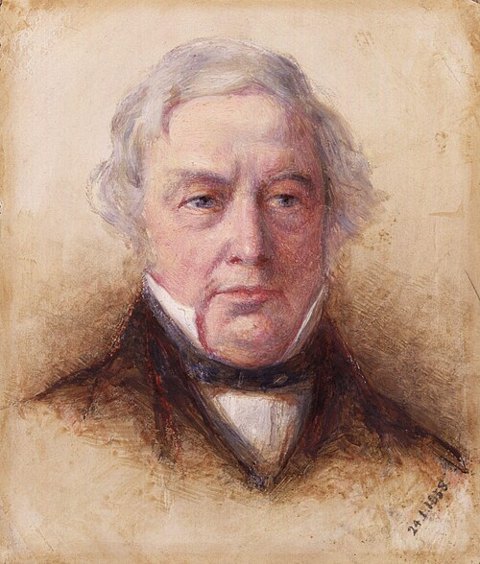
Thomas Love Peacock (18 October 1785 – 23 January 1866) was an English novelist, poet, and official of the East India Company. He was a close friend of Percy Bysshe Shelley, and they influenced each other's work. Peacock wrote satirical novels, each with the same basic setting: characters at a table discussing and criticising the philosophical opinions of the day.
Background and education
Peacock was born in Weymouth, Dorset, the son of Samuel Peacock and his wife Sarah Love, daughter of Thomas Love, a retired master of a man-of-war in the Royal Navy. His father was a glass merchant in London, partner of a Mr Pellatt, presumed to be Apsley Pellatt (1763–1826). Peacock went with his mother to live with her family at Chertsey in 1791 and in 1792 went to a school run by Joseph Harris Wicks at Englefield Green where he stayed for six and a half years.
Peacock's father died in 1794 in "poor circumstances" leaving a small annuity. Peacock's first known poem was an epitaph for a school fellow written at the age of ten, and another on his Midsummer Holidays was written when he was thirteen. Around that time in 1798 he was abruptly taken from school and from then on was entirely self-educated.
Early occupation and travelling
In February 1800, Peacock became a clerk with Ludlow Fraser Company, who were merchants in the City of London. He lived with his mother on the firm's premises at 4 Angel Court Throgmorton Street. He won the eleventh prize from the Monthly Preceptor for a verse answer to the question "Is History or Biography the More Improving Study?". He also contributed to "The Juvenile Library", a magazine for youth whose competitions excited the emulation of several other boys including Leigh Hunt, de Quincey, and W. J. Fox. He began visiting the Reading Room of the British Museum and continued doing so for many years, diligently studying the best literature in Greek, Latin, French, and Italian. In 1804 and 1806 he published two volumes of poetry, The Monks of St. Mark and Palmyra. Some of Peacock's juvenile compositions were privately printed by Sir Henry Cole.