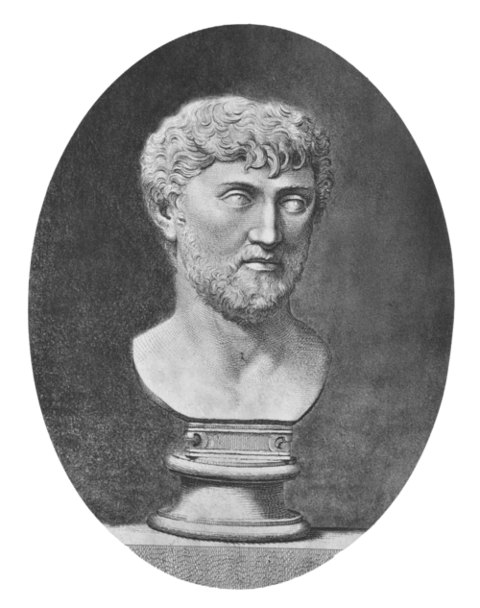
Titus Lucretius Carus (TY-tuhs loo-KREE-shuhs; Latin: [ˈtitʊs lʊˈkreːtɪ.ʊs ˈkaːrʊs]; c. 99 – October 15, 55 BC) was a Roman poet and philosopher. His only known work is the philosophical poem De rerum natura, a didactic work about the tenets and philosophy of Epicureanism, which usually is translated into English as On the Nature of Things—and somewhat less often as On the Nature of the Universe.
Very little is known about Lucretius's life; the only certainty is that he was either a friend or client of Gaius Memmius, to whom the poem was addressed and dedicated. De rerum natura was a considerable influence on the Augustan poets, particularly Virgil (in his Aeneid and Georgics, and to a lesser extent on the Eclogues) and Horace. The work was almost lost during the Middle Ages, but was rediscovered in 1417 in a monastery in Germany by Poggio Bracciolini. It played an important role both in the development of atomism (Lucretius was an important influence on Pierre Gassendi) and the efforts of various figures of the Enlightenment era to construct a new Christian humanism.