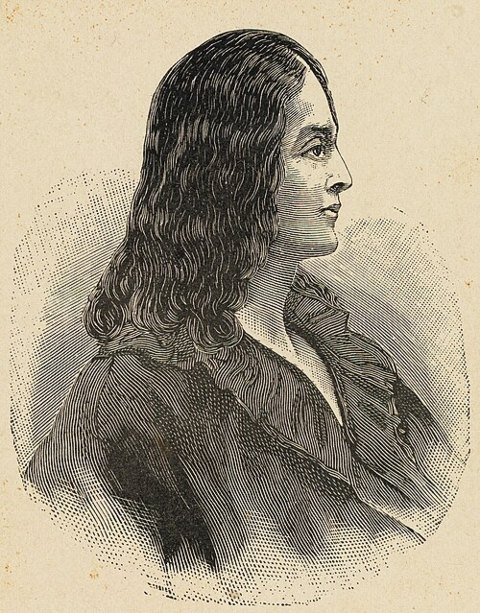
Tomás António Gonzaga (11 August 1744 – c. 1810) was a Portuguese poet. One of the most famous Neoclassic writers in colonial Brazil, he was also the ouvidor and the ombudsman of the city of Ouro Preto (formerly "Vila Rica"), as well as the desembargador of the appeal court in Bahia. He wrote under the pen name Dirceu.
He is patron of the 37th chair of the Brazilian Academy of Letters.
Biography
Gonzaga was born in the freguesia (or parish) of Miragaia, in Porto, to João Bernardo Gonzaga and Tomásia Isabel Clark, who was of British descent. Tomásia died when Gonzaga was 1 year old, and soon after his mother's death, he and his father moved to Recife, and then to Bahia, where João Bernardo served at the magistrature and was desembargador of the appeal court, and Gonzaga studied at a Jesuit school. Gonzaga was sent back to Portugal as a teenager, to the University of Coimbra, to finish his studies and, at 24 years old, he finished his Law course. He presented himself as a candidate for a chair at the University, with the thesis Tratado de Direito Natural, heavily influenced by Enlightenment ideals.
Gonzaga became the juiz de fora of the city of Beja in 1778, until 1781. In the following year, he returned to Brazil, becoming the ouvidor of the city of Vila Rica (nowadays Ouro Preto). He held this post until 1789, when he was accused of being involved with the Minas Conspiracy. Arrested, he was sent to a prison in Ilha das Cobras, Rio de Janeiro. He spent three years in prison, and although he asserted his innocence, the authorities were influenced by his friendship with the conspirators. In 1792 he was sentenced to perpetual exile in Angola, later commuted to a ten-year exile on the Island of Mozambique. By that time, he was engaged to a woman named Maria Doroteia Joaquina de Seixas Brandão, possibly the "Marília" of his verses. His hope of being freed from his prison in order to see his beloved again is a prominent theme of the second part of his poetry book Marília de Dirceu.