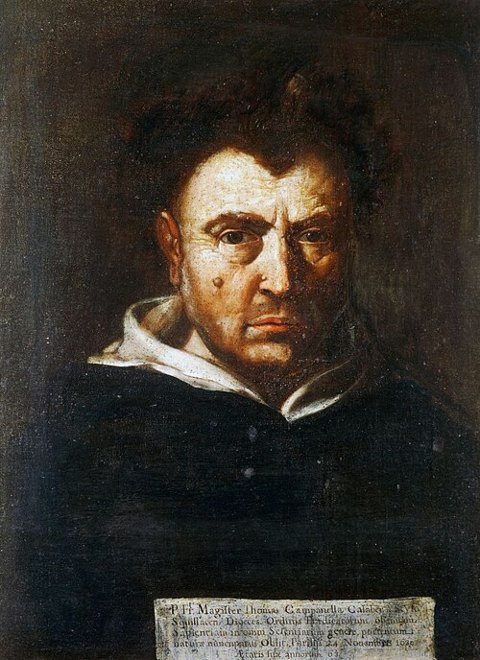
Tommaso Campanella (Italian: [tomˈmaːzo kampaˈnɛlla]; 5 September 1568 – 21 May 1639), baptized Giovanni Domenico Campanella, was an Italian Dominican friar, philosopher, theologian, astrologer, and poet.
Campanella was prosecuted by the Roman Inquisition for heresy in 1594 and was confined to house arrest for two years. Accused of conspiring against the Spanish rulers of Calabria in 1599, he was tortured and sent to prison, where he spent 27 years. He wrote his most significant works during this time, including The City of the Sun, a utopia describing an egalitarian theocratic society where property is held in common.
Biography
Born into poverty in Stignano, in the province of Reggio di Calabria in Calabria, southern Italy, Campanella was a child prodigy. Son of an illiterate cobbler, he entered the Dominican Order before the age of fourteen, taking the name of fra' Tommaso in honour of Thomas Aquinas. He studied theology and philosophy with several masters.
Early on, he became disenchanted with the Aristotelian orthodoxy and attracted by the empiricism of Bernardino Telesio (1509–1588), who taught that knowledge is sensation and that all things in nature possess sensation. Campanella wrote his first work, Philosophia sensibus demonstrata ("Philosophy demonstrated by the senses"), published in 1592, in defence of Telesio.
In 1590 he was in Naples where he was initiated in astrology; astrological speculations would become a constant feature in his writings. Campanella's heterodox views, especially his opposition to the authority of Aristotle, brought him into conflict with the ecclesiastical authorities. Denounced to the Roman Inquisition, he was arrested in Padua in 1594 and cited before the Holy Office in Rome, he was confined in a convent until 1597.