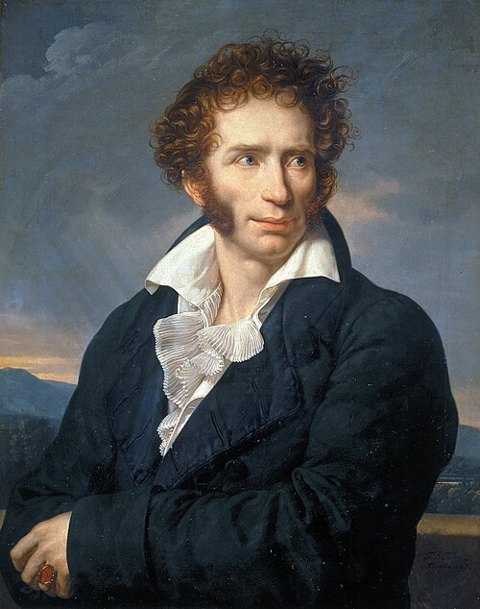
Ugo Foscolo (Italian: [ˈuːɡo ˈfoskolo, fɔs-]; 6 February 1778 – 10 September 1827), born Niccolò Foscolo, was an Italian writer, revolutionary and poet.
He is remembered for his 1807 long poem Dei Sepolcri, for writing what is considered the first modern Italian novel, The Last Letters of Jacopo Ortis (1798), and the carmen The Graces (1812).
Early life
Foscolo was born in Zakynthos in 1778, in the Ionian Islands. His father Andrea Foscolo was an impoverished Venetian nobleman and medical doctor, and his mother Diamantina Spathis was Greek.
In 1788, upon the death of his father, who worked as a physician in Spalato (present-day Split, Croatia), the family moved to Venice, and Foscolo completed the studies he began at the Dalmatian grammar school at the University of Padua.
Amongst his Paduan teachers was the Abbé Melchiore Cesarotti, whose version of Ossian was very popular in Italy, and who influenced Foscolo's literary tastes; he knew both modern and Ancient Greek. His literary ambition revealed itself in the appearance in 1797 of his tragedy Tieste—a production that enjoyed a certain degree of success.
Politics and poetry
Foscolo, who, for unknown reasons, had changed his Christian name Niccolò to that of Ugo, began to take an active part in the stormy political discussions which the fall of the Republic of Venice had triggered. He was a prominent member of the national committees, and addressed an ode to Napoleon, expecting Napoleon to overthrow the Venetian oligarchy and create a free republic.
The Treaty of Campo Formio (17 October 1797), under which, the French having indeed forced the dissolution of the ancient Republic of Venice, then handed over the city and the Veneto to the Austrians (in exchange for the Austrian Netherlands) gave a rude shock to Foscolo, but did not quite destroy his hopes. The state of mind produced by that shock is reflected in his novel The Last Letters of Jacopo Ortis (1798), which was described by the 1911 Encyclopædia Britannica as a more politicized version of Johann Wolfgang von Goethe's The Sorrows of Young Werther: "for Foscolo's hero embodies the mental sufferings and suicide of an undeceived Italian patriot just as Goethe's hero places before us the too-delicate sensitiveness, embittering and at last cutting short the life of a private German scholar."