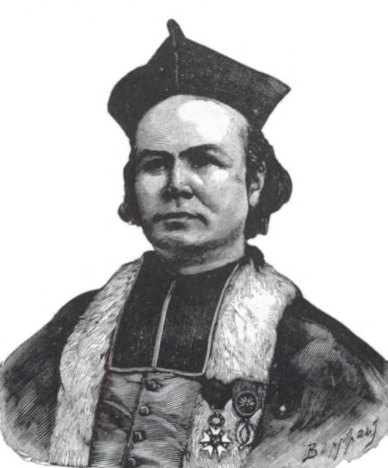
Cyr Joseph Ulysse Chevalier (24 February 1841 – 27 October 1923) was a French Catholic priest, bibliographer, and historian who specialized in the European Middle Ages. He is principally remembered for his Répertoire des sources historiques du Moyen Âge ("Repertory of historical sources on the Middle Ages") and for his critical work on the authenticity of the Shroud of Turin and the Holy House of Loreto.
Life and works
Chevalier was born in 1841 Rambouillet in the Île-de-France region, where his father was stationed as a military physician. In 1852 the family returned to its hometown in Romans-sur-Isère in southeastern France, where Chevalier pursued ecclesiastical studies and was ordained as a Catholic priest in 1867. Under the guidance of Léopold Victor Delisle, to whom he had been recommended, Chevalier launched a scholarly career focused primarily on the history of the Dauphiné.
Chevalier's historical works include studies of the cartularies of the church and of the town of Die (1868), of the abbey of Saint-André-le-Bas in Vienne (1869), of Bonnevaux Abbey (1889), and of the abbey of Saint-Chaffre at Le Monastier-sur-Gazeille (1884). Chevalier also compiled inventories of the archives of the dauphins of Viennois, and a Bibliothèque liturgique in six volumes (1893–1897), the third and fourth volumes of which constitute the Repertorium hymnologicum, containing more than 20,000 articles.
Chevalier's principal scholarly contribution is the Répertoire des sources historiques du Moyen Âge. The first part, Bio-bibliographie (1875–1886), contains the names of all the historical personages alive between the years 1 and 1500 who are mentioned in printed books, together with precise references. The second part, Topo-bibliographie (1894–1903), contains not only the names of places mentioned in books on the history of the Middle Ages, but, in a general way, everything not included in the Bio-bibliographie.