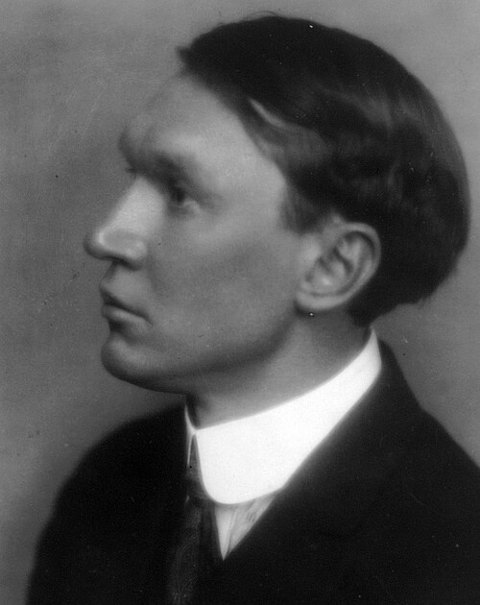
Nicholas Vachel Lindsay (November 10, 1879 – December 5, 1931) was an American poet. He is considered a founder of modern singing poetry, as he referred to it, in which verses are meant to be sung or chanted.
Early years
Lindsay was born in Springfield, Illinois where his father, Vachel Thomas Lindsay, worked as a medical doctor and had amassed considerable wealth. The Lindsays lived across the street from the Illinois Executive Mansion, home of the Governor of Illinois. The location of his childhood home influenced Lindsay, and one of his poems, "The Eagle That Is Forgotten," eulogizes Illinois governor John P. Altgeld, whom Lindsay admired for his courage in pardoning the anarchists involved in the Haymarket Affair, despite the strong protests of US President Grover Cleveland.
Growing up in Springfield influenced Lindsay in other ways, as evidenced in such poems as "On the Building of Springfield," and culminating in poems praising Springfield's most famous resident, Abraham Lincoln. In "Lincoln", Lindsay exclaims, "Would I might rouse the Lincoln in you all!" This line was later adopted as the official motto of the Association of Lincoln Presenters. In his 1914 poem, "Abraham Lincoln Walks at Midnight (In Springfield, Illinois)", Lindsay specifically places Lincoln in Springfield, with the poem's opening:
It is portentous, and a thing of state
That here at midnight, in our little town
A mourning figure walks, and will not rest...
Lindsay studied medicine at Ohio's Hiram College from 1897 to 1900, but he did not want to be a doctor; his parents were pressuring him toward medicine. Once, he wrote to them that he wasn't meant to be a doctor, but a painter; they wrote back, and replied that doctors can draw pictures in their free time. He left Hiram anyway, heading to Chicago to study at the Art Institute of Chicago from 1900 to 1903. In 1904, he left to attend the New York School of Art (now The New School) to study pen and ink. Lindsay remained interested in art for the rest of his life, drawing illustrations for some of his poetry. His art studies also probably led him to appreciate the new art form of silent film. His 1915 book, The Art of the Moving Picture, is generally considered the first book of film criticism, according to critic Stanley Kauffmann, discussing Lindsay in For the Love of Movies: The Story of American Film Criticism.