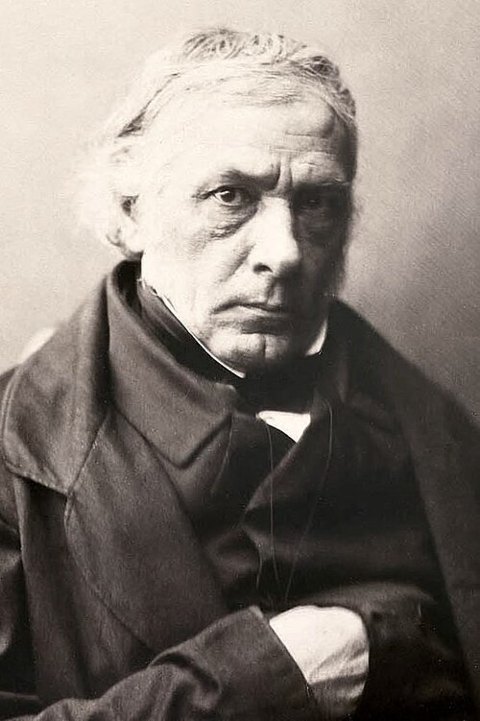
Victor Cousin (French: [kuzɛ̃]; 28 November 1792 – 14 January 1867) was a French philosopher. He was the founder of "eclecticism", a briefly influential school of French philosophy that combined elements of German idealism and Scottish Common Sense Realism. As the administrator of public instruction for over a decade, Cousin also had an important influence on French educational policy.
Early years
The son of a watchmaker, he was born in Paris, in the Quartier Saint-Antoine. At the age of ten, he was sent to the local grammar school, the Lycée Charlemagne, where he studied until he was eighteen. Lycées, being organically linked to the University of France and its Faculties since their Napoleonic institution (the baccalauréat was awarded by juries made of university professors), Cousin was "crowned" in the ancient hall of the Sorbonne for a Latin oration he wrote, which earned him a first prize at the concours général, a competition of the best pupils at lycées (established under the Ancien Régime and reinstated under the First French Empire, and still extant). The classical training of the lycée strongly disposed him to literature, or éloquence as it was then called. He was already known among his fellow students for his knowledge of Greek. From the lycée, he graduated to the most prestigious of higher education schools, École Normale Supérieure (then called École Normale), where Pierre Laromiguière was then lecturing on philosophy.
In the second preface to the Fragments philosophiques, in which he candidly states the varied philosophical influences of his life, Cousin speaks of the grateful emotion excited by the memory of the day when he heard Laromiguière for the first time. "That day decided my whole life." Laromiguière taught the philosophy of John Locke and Étienne Bonnot de Condillac, happily modified on some points, with a clearness and grace which in appearance at least removed difficulties, and with a charm of spiritual bonhomie which penetrated and subdued." That school has remained ever since the living heart of French philosophy; Henri Bergson, Jean-Paul Sartre and Jacques Derrida are among its past students.