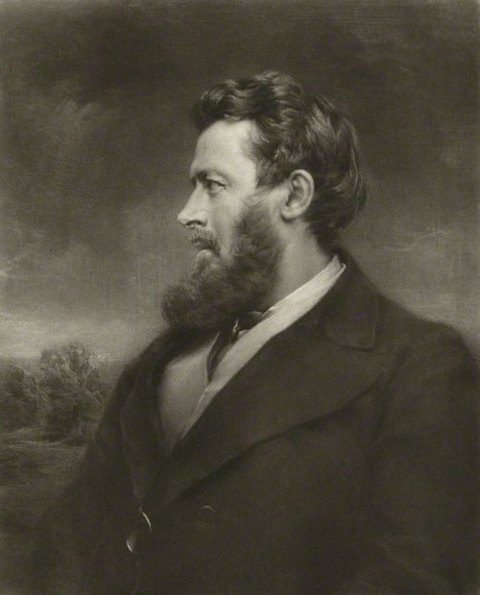
Walter Bagehot (BAJ-ət; 3 February 1826 – 24 March 1877) was an English journalist, businessman, and essayist, who wrote extensively about government, economics, literature and race. He is known for co-founding the National Review in 1855, and for his works The English Constitution and Lombard Street: A Description of the Money Market (1873).
Life
Bagehot was born in Langport, Somerset, England, on 3 February 1826. His father, Thomas Watson Bagehot, was managing director and vice-chairman of Stuckey's Bank. He attended University College London (UCL), where he studied mathematics and, in 1848, earned a master's degree in moral philosophy. Bagehot was called to the Bar by Lincoln's Inn, but preferred to join his father in 1852 in his family's shipping and banking business.
In 1858, Bagehot married Elizabeth (Eliza) Wilson (1832–1921), whose father, James Wilson, was the founder and owner of The Economist. The couple were happily married until Bagehot's untimely death at age 51, but had no children. A collection of their love-letters was published in 1933.
Journalism
In 1855, Bagehot founded the National Review with his friend Richard Holt Hutton. In 1861, he became editor-in-chief of The Economist. In the 16 years he served as its editor, Bagehot expanded the reporting of politics by The Economist, and increased its influence among policy-makers. He was widely accepted by the British establishment and was elected to the Athenaeum in 1875.
He considered himself a "conservative Liberal or 'between size in politics.'"