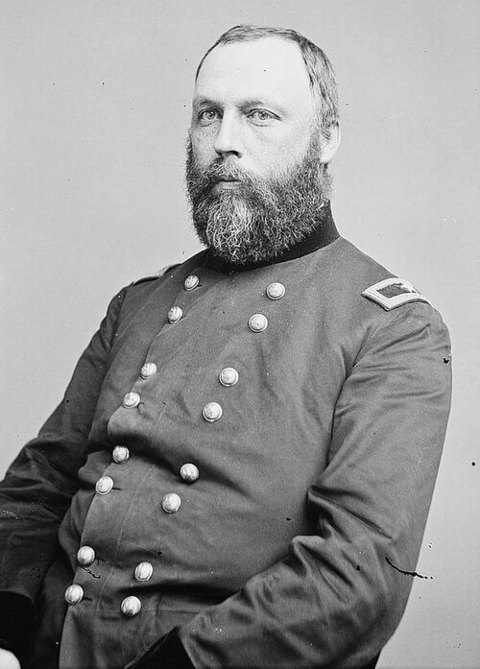
William Alexander Hammond (28 August 1828 – 5 January 1900) was an American military physician and neurologist. During the American Civil War he was the eleventh Surgeon General of the United States Army (1862–1864) and the founder of the Army Medical Museum (now the National Museum of Health and Medicine).
He was the first American physician to devote himself entirely to neurology, the author of the first American treatise about neurology, and one of the founders of the American Neurological Association.
Biography
Born in Annapolis (Maryland), Hammond grew up in Harrisburg (Pennsylvania). He received his M.D. from New York University at the age of 20. After his internship and a few months in private practice he became assistant-surgeon in the United States Army, serving from 1849 to 1860. He was first sent to New Mexico and took part in the Sioux Wars. While on sick leave, he visited military hospitals in Europe. He conducted research over many years and the resulting paper was awarded a prize by the American Medical Association in 1857. With a common interest in poisons acting on the nervous system (among them snake venom), he wrote a paper with Silas Weir Mitchell that was published in 1859. He was elected to the American Philosophical Society that same year.
While serving at Fort Riley as medical director, Hammond also collected biological specimens. In 1860 he accepted a chair of anatomy and physiology at the University of Maryland School of Medicine in Baltimore and left the army.
Civil War
When the American Civil War broke out Hammond spent some time at the Baltimore infirmary then joined the army (without recognition of his past service) on 28 May 1861, a month a half after the beginning of the hostilities. Surgeon General Clement Finley soon transferred him to West Virginia under the command of General William Starke Rosecrans command "to lessen his visibility". There Hammond met Jonathan Letterman. Hammond worked with Letterman and Rosecrans on the design of a new ambulance wagon.