Author
William Ames
English Protestant divine, philosopher, and controversialist
- Born
- 1576, Ipswich
- Died
- November 14, 1633, Rotterdam
- Nationality
- Kingdom of England
- Occupation
- Theologian, philosopher, university teacher and parson
Life and work
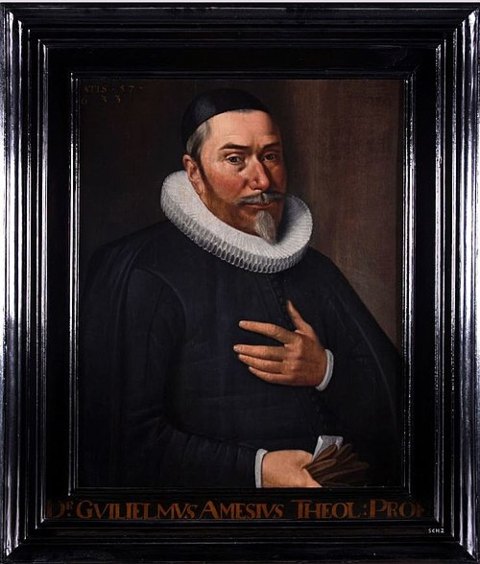
William Ames (Latin: Guilielmus Amesius; 1576 – 14 November 1633) was an English Puritan minister, philosopher, and controversialist. He spent much time in the Netherlands, and is noted for his involvement in the controversy between the Calvinists and the Arminians.
Early life and education
Ames was born at Ipswich, and was brought up by a maternal uncle, Robert Snelling of Boxford. He was educated at the local grammar school and from 1594 at Christ's College, Cambridge. He was considerably influenced by his tutor at Christ's, William Perkins, and by his successor Paul Bayne. Ames graduated BA in 1598 and MA in 1601, and was chosen for a fellowship in Christ's College.
He was popular in the university, and in his own college. One of Ames's sermons became historical in the Puritan controversies. It was delivered in the university Church of St Mary the Great, Cambridge on 21 December 1609, and in it he rebuked sharply "lusory lotts" and the "heathenish debauchery" of the students during the Twelve Days of Christmas.
A partisan election, however, had led to the mastership at Christ's going to Valentine Carey. He quarrelled with Ames for disapproving of the surplice and other outward symbols. Ames's vehemence led to his being summoned before the Vice-Chancellor, who suspended him "from the exercise of his ecclesiastical function and from all degrees taken or to be taken."
Ministry in Holland
He left Cambridge, and was offered a lecturer position at Colchester, but George Abbot, the Bishop of London, went against the wishes of the local corporation, and refused to grant institution and induction. Similar rebuffs awaited him elsewhere, and he travelled with Robert Parker to the Netherlands, helped by English merchants who wished him to controvert the supporters of the English church in Leiden. At Rotterdam, he debated with Grevinchovius (Nicholas Grevinckhoven, died 1632), minister of the Arminian party, with reasoning from Philippians ii. 13, "It is God that worketh in us both to will and to do."
Text: “William Ames”, from Wikipedia, the free encyclopedia, under the license CC BY-SA 4.0. Dates and facts: Wikidata.
Collection
Books by William Ames
1 book