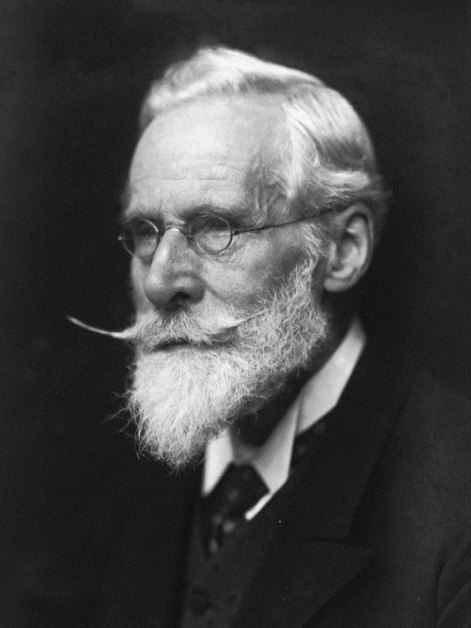
Author
William Crookes
British chemist and physicist (1832-1919)
- Born
- June 17, 1832, London
- Died
- April 4, 1919, London
- Nationality
- United Kingdom of Great Britain and Ireland
- Occupation
- Chemist, physicist, psychic and photographer
- Notable works
- Crookes tube · Crookes radiometer · discovery
Life and work
Sir William Crookes (17 June 1832 – 4 April 1919) was an English chemist and physicist who attended the Royal College of Chemistry, now part of Imperial College London, and worked on spectroscopy. He was a pioneer of vacuum tubes, inventing the Crookes tube, which was made in 1875. Observing cathode rays generated in these tubes, Crookes posited that "radiant matter" was a unique fourth state of matter, a foundational contribution to plasma physics.
He is credited with discovering the element thallium, announced in 1861, with the help of spectroscopy. He was also the first to describe the spectrum of terrestrial helium, in 1865. Crookes was the inventor of the Crookes radiometer, but did not discern the true explanation of the phenomenon he detected.
According to historian William H. Brock, Crookes's later work on ultraviolet eye protection arose from 1907 Royal Society investigations into cataracts among furnace and glass workers. Developed in partnership with Wigmore Street opticians Sir William Wingate and Frank Melson Wingate, by 1918 the resulting 'Crookes Lenses' under Melson Wingate Ltd combined scientific research with practical industrial safety as a manufactured product. Brock argues that this work laid the foundation for the modern sunglasses industry, while the lenses themselves were applied to industrial, military and aviation applications for much of the twentieth century, until modern sunglass branding gradually superseded them.
Text: “William Crookes”, from Wikipedia, the free encyclopedia, under the license CC BY-SA 4.0. Dates and facts: Wikidata.
Collection
Books by William Crookes
1 book