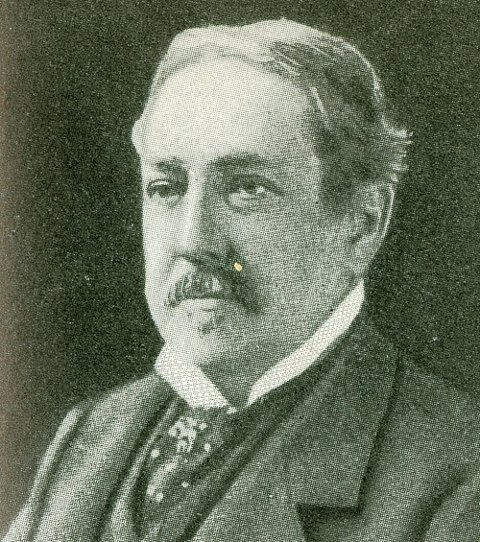
William Dudley Foulke (November 20, 1848 – May 30, 1935) was an American literary critic, journalist, poet, and reformer.
Biography
William Dudley Foulke was born in New York City on November 20, 1848. He graduated Columbia University in 1869, where he was a member of the Philolexian Society,
and Columbia Law School in 1871. He practiced law in New York until 1876, when he moved to Richmond, Indiana, and married Mary Taylor Reeves.
Foulke became involved in local politics and was elected to the Indiana Senate, serving from 1882 to 1886. As a senator, he introduced bills to reform the state's civil service system. In addition, he investigated abuses against inmates and employees at the state hospital for the insane. He served on the Platform Committee of the Progressive Party. In 1889 he was asked by the National Civil Service Reform League to investigate the U.S. Federal civil service. President Theodore Roosevelt appointed Foulke a Commissioner in the Civil Service Commission in 1901.
He was a critic of the Ku Klux Klan, which had strong membership in Richmond and was threatened with flogging for his views.
He was also one of the early presidents of the American Woman Suffrage Association, the first president of the Proportional Representation League, and (for five years) president of the National Municipal League.
As a writer, Foulke wrote on several diverse subjects. In 1898, he published a biography of Oliver Hazard Perry Morton. Later, he translated the medieval History of the Lombards by Paul the Deacon. His other works include Biographical Introduction to Some Love Poems of Petrarch (1916). Some of his poems include Honor to France. Foulke wrote two memoirs: Fighting the Spoilsmen (1919), where he recounted his career in fighting for civil service reform. There followed a more general reminiscence, A Hoosier Autobiography (1922).