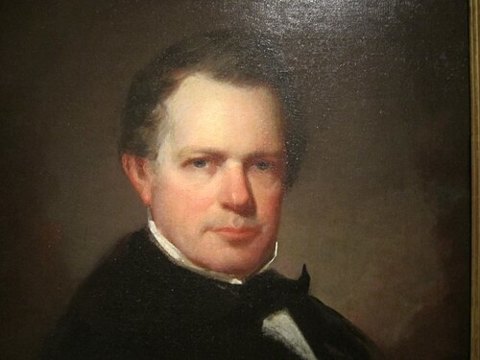
William Gilmore Simms (April 17, 1806 – June 11, 1870) was an American poet, novelist, politician and historian from the American South. His writings achieved great prominence during the 19th century, with Edgar Allan Poe pronouncing him the best novelist America had ever produced. He is still known among literary scholars as a major force in antebellum Southern literature. He is also remembered for his strong support of slavery and for his opposition to Uncle Tom's Cabin, in response to which he wrote reviews and the pro-slavery novel The Sword and the Distaff (1854). During his literary career he served as editor of several journals and newspapers and he also served in the South Carolina House of Representatives.
Early and family life
Simms was born on April 17, 1806, in Charleston, South Carolina, of Scots-Irish ancestors. His mother, Harriet Ann Augusta (née Singleton, 1784–1808) died during his infancy; his father William Gilmore Simms Senior (1762–1830) failed in business and joined Coffee's Indian fighters. Simms was raised by his maternal grandmother, Jane Miller Singleton Gates, who had lived through the American Revolutionary War and who told Simms stories about it.
In his teen years, Simms worked as a clerk in a drugstore and aspired to study medicine. Simms began to study law when he was eighteen (circa 1824). He received an honorary LLD from the University of Alabama in 1841.
He married Anna Malcolm Giles in 1826. After her death, he married Chevillette Eliza Roach (pronounced "Roche"), with whom he had 14 children, only 5 of whom lived to adulthood. He was admitted to the South Carolina bar in 1827; however, he soon abandoned this profession for literature.