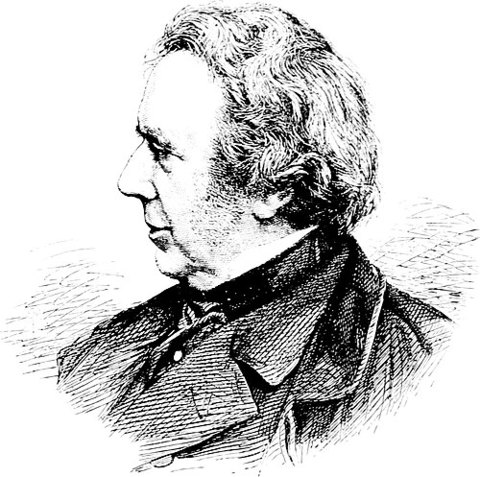
William Harvey (13 July 1796 – 13 January 1866) was a British wood-engraver and illustrator.
Born at Newcastle upon Tyne, Harvey was the son of a bath-keeper. At the age of 14, he was apprenticed to Thomas Bewick, and became one of his favorite pupils. Bewick describes him as one "who both as an engraver & designer, stands preeminent" at his day (Memoir, p. 200). He engraved many woodblocks for Bewick's Aesop's Fables (1818).
Harvey moved to London in 1817, studying drawing with Benjamin Haydon, and anatomy with Charles Bell. In 1821, he made a wood-engraving after Haydon in imitation of engraving, the large block of the Assassination of L. S. Dentatus. This was probably the then most ambitious woodblock which had been cut in England.
Harvey switched to design, after the death of John Thurston, the then leading wood designer in London. One of his earliest works is his illustrations for Alexander Henderson's History of Ancient and Modern Wines in 1824.
His masterpieces are his illustrations to Northcote's Fables (1823–33) and to E. W. Lane's The Arabian Nights' Entertainments (1838–40).
Harvey died at Prospect Lodge, The Vineyard, Richmond and is buried in Richmond Old Burial Ground.