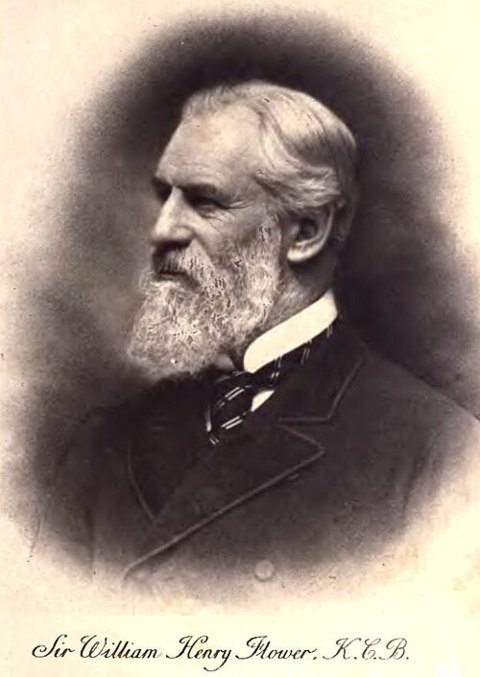
Author
William Henry Flower
English comparative anatomist, surgeon and museum curator (1831–1899)
- Born
- November 30, 1831, Stratford-upon-Avon
- Died
- July 1, 1899, London
- Nationality
- United Kingdom of Great Britain and Ireland
- Occupation
- Military physician, zoologist, scientific illustrator, comparative anatomist and surgeon
Life and work
Sir William Henry Flower (30 November 1831 – 1 July 1899) was an English surgeon, museum curator and comparative anatomist, who became a leading authority on mammals and especially on the primate brain. He supported Thomas Henry Huxley in an important controversy with Richard Owen about the human brain and eventually succeeded Owen as Director of the Natural History Museum in London.
Origins and early years
Born on 30 November 1831 in his father's house at Stratford-upon-Avon in Warwickshire, he was the second son of Edward Fordham Flower, founder of the town brewery, and his wife Celina Greaves (1804–1884), eldest daughter of John Greaves and his wife Mary Whitehead. His paternal grandfather Richard Flower had married Elizabeth Fordham on 24 Dec 1786 in St Andrew's Church, Newcastle upon Tyne, and settled at Albion, Illinois, where their children grew up.
His uncles included the slate entrepreneur John Whitehead Greaves and William Pickering, Governor of Washington. His elder brother Charles Edward Flower ran the family brewery with the third brother Edgar Flower, while he chose a scientific career.
First taught at home by his mother, he went to a school in Edgbaston at the age 11 and then from age 13 to a Pestalozzian school at Worksop under a Swiss headmaster, Dr B. Heldenmaier. There were ten hours schooling each day which included, rare at that time, science. Already a collector of natural history objects, he was made curator of the school museum and for almost all the rest of his life was a museum curator of one kind or another.
Text: “William Henry Flower”, from Wikipedia, the free encyclopedia, under the license CC BY-SA 4.0. Dates and facts: Wikidata.
Collection
Books by William Henry Flower
1 book