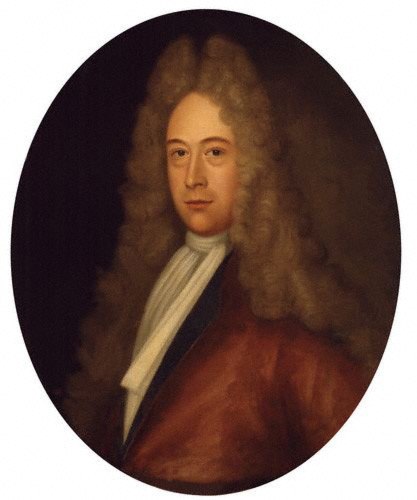
William Somervile or Somerville (2 September 1675 – 17 July 1742) was an English poet who wrote in many genres and is especially remembered for "The Chace", in which he pioneered an early English georgic.
Life
Somervile, the eldest son of a long established country family, was born in Staffordshire in 1677. He was a descendant of Roger de Somerville, of an English branch of the Somerville Family. William raised at the family seat of Edstone, near Wootton Wawen in Warwickshire. He was educated at Winchester College and at New College, Oxford, and then studied law at the Middle Temple. After his father's death in 1705 he lived on his estate and devoted himself to the field sports which were eventually to supply the subjects of his best-known poems. Among his friends and neighbours were the poets William Shenstone, Richard Jago and George Lyttelton, 1st Baron Lyttelton. Later he was a correspondent of Allan Ramsay and they exchanged poems. But Somervile's convivial hospitality strained his small personal income and plunged him into debt. Eventually he took to drinking heavily and died on 17 July 1742 at the age of 66. After his death he was buried in the church at Wootton Wawen and his estate passed to James Lord Somerville under an arrangement in which Lord Somerville had lent him money to pay his debts.
Following Somervile's death, William Shenstone paid him a tribute in a letter which hints at the strained relations with his friends in later life:
Our old friend Somervile is dead! I did not imagine I could have been so sorry as I find myself on the occasion. Sublatum querimus. I can now excuse all his foibles: impute them to age, and to distress of circumstances. The last of these circumstances wrings my very soul to think on. For a man of high spirit, conscious of having (at least in one production) generally pleased the world, to be plagued and threatened by wretches that are low in every sense: to be forced to drink himself into pains of the body, in order to get rid of pains of the mind, is misery indeed.