

Memoirs of General William T. Sherman — Complete
Online reading View book
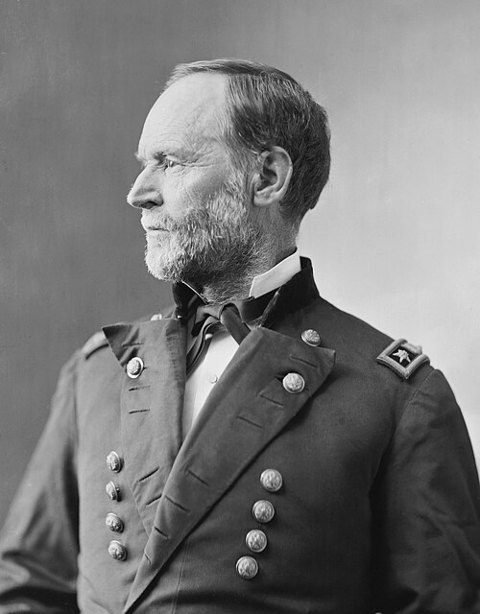
Author
United States Army general (1820–1891)
William Tecumseh Sherman (tih-KUM-sə; February 8, 1820 – February 14, 1891) was an American businessman, author, and United States Army general in the Union army during the American Civil War (1861–1865). As a general he earned recognition for his command of military strategy but criticism for the harshness of his scorched-earth policies, which he implemented in his military campaign against the Confederate States.
Born in Lancaster, Ohio, into a politically prominent family, Sherman graduated in 1840 from the United States Military Academy in West Point. In 1853, he interrupted his military career to pursue private business ventures, without much success. In 1859, he became superintendent of the Louisiana State Seminary of Learning & Military Academy, now Louisiana State University, but resigned when Louisiana seceded from the Union. Sherman commanded a brigade of volunteers at the First Battle of Bull Run in 1861, and then was transferred to the western theater. He was stationed in Kentucky, where his pessimism about the outlook of the war led to a breakdown that required him to be briefly put on leave. He recovered and forged a close partnership with General Ulysses S. Grant. Sherman served under Grant in 1862 and 1863 in the Battle of Fort Henry and the Battle of Fort Donelson, the Battle of Shiloh, the campaigns that led to the fall of the Confederate stronghold of Vicksburg on the Mississippi River, and the Chattanooga campaign, which culminated with the routing of the Confederate armies in the state of Tennessee.
In 1864, when Grant went east to serve as the General-in-Chief of the Union Armies, Sherman succeeded him as the commander in the western theater. He led the capture of the strategic city of Atlanta, a military success that contributed to the re-election of President Abraham Lincoln. Sherman's subsequent famous "March to the Sea" through Georgia and the Carolinas involved little fighting but large-scale destruction of military and civilian infrastructure, a systematic policy intended to undermine the ability and willingness of the Confederacy to continue fighting. Sherman accepted the surrender of all the Confederate armies in the Carolinas, Georgia, and Florida in April 1865, but the terms that he negotiated were considered too generous by U.S. Secretary of War Edwin Stanton, who ordered General Grant to modify them.
When Grant became President of the United States in March 1869, Sherman succeeded him as Commanding General of the Army. Sherman served in that capacity from 1869 until 1883 and was responsible for the U.S. Army's engagement in the Indian Wars, in which he used "hard-war" tactics similar to those he had employed in the Civil War. He steadfastly refused to be drawn into party politics. In 1875, he published his memoirs, which became one of the best-known first-hand accounts of the Civil War.
Text: “William Tecumseh Sherman”, from Wikipedia, the free encyclopedia, under the license CC BY-SA 4.0. Dates and facts: Wikidata.
Collection
1 book
Humanities
William T. Sherman