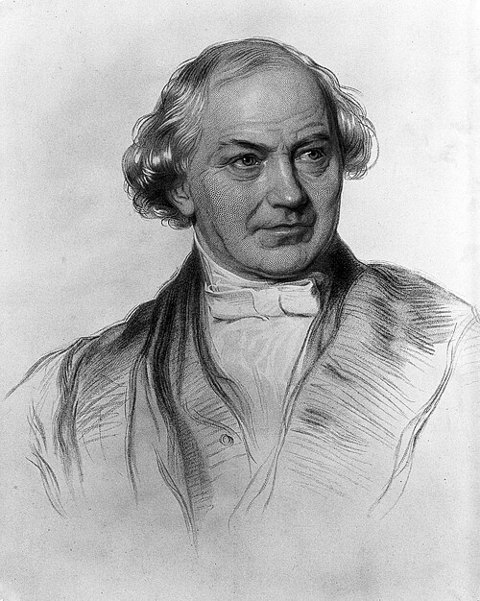
William Whewell (HEW-əl; 24 May 1794 – 6 March 1866) was an English polymath. He was Master of Trinity College, Cambridge. In his time as a student there, he achieved distinction in both poetry and mathematics.
The breadth of Whewell's endeavours is his most remarkable feature. In a time of increasing specialisation, Whewell belonged in an earlier era when natural philosophers investigated widely. He published work in mechanics, physics, geology, astronomy, and economics, while also composing poetry, writing a Bridgewater Treatise, translating the works of Goethe, and writing sermons and theological tracts. In mathematics, Whewell introduced what is now called the Whewell equation, defining the shape of a curve without reference to an arbitrarily chosen coordinate system. He also organized thousands of volunteers internationally to study ocean tides, in what is now considered one of the first citizen science projects. He received the Royal Medal for this work in 1837.
One of Whewell's greatest gifts to science was his wordsmithing. He corresponded with many in his field and helped them come up with neologisms for their discoveries. Whewell coined, among other terms, scientist, physicist, linguistics, consilience, catastrophism, uniformitarianism, and astigmatism; he suggested to Michael Faraday the terms electrode, ion, dielectric, anode, and cathode.