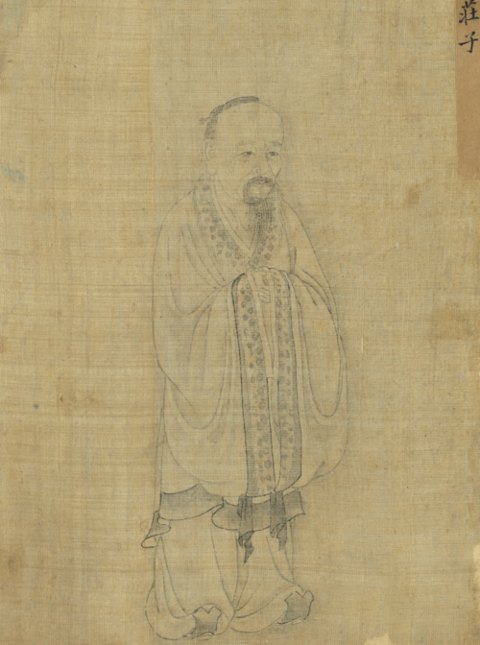
Zhuang Zhou (US:, UK:), honorifically often known as Zhuangzi (US:), was an influential Chinese philosopher who lived around the 4th century BCE during the Warring States period, a period of great development in Chinese philosophy, the Hundred Schools of Thought. He is credited with writing—in part or in whole—a work known by his name, the Zhuangzi, which is one of two foundational texts of Taoism, alongside the Tao Te Ching.
Life
The only account of the life of Zhuangzi is a brief sketch in chapter 63 of Sima Qian's Records of the Grand Historian, and most of the information it contains seems to have simply been drawn from anecdotes in the Zhuangzi itself. In Sima's biography, he is described as a minor official from the town of Meng (in modern Anhui) in the state of Song, living in the time of King Hui of Liang and King Xuan of Qi (late fourth century BC). Sima Qian writes that Zhuangzi was especially influenced by Laozi, and that he turned down a job offer from King Wei of Chu, because he valued his personal freedom.
His existence has been questioned by Russell Kirkland, who asserts that "there is no reliable historical data at all" for Zhuang Zhou, and that most of the available information on the Zhuangzi comes from its third-century commentator, Guo Xiang.
Writings
Zhuangzi is traditionally credited as the author of at least part of the work bearing his name, the Zhuangzi. This work, in its current shape consisting of 33 chapters, is traditionally divided into three parts: the first, known as the "Inner Chapters", consists of the first seven chapters; the second, known as the "Outer Chapters", consist of the next 15 chapters; the last, known as the "Mixed Chapters", consist of the remaining 11 chapters. The meaning of these three names is disputed: according to Guo Xiang, the "Inner Chapters" were written by Zhuangzi, the "Outer Chapters" written by his disciples, and the "Mixed Chapters" by other hands; the other interpretation is that the names refer to the origin of the titles of the chapters—the "Inner Chapters" take their titles from phrases inside the chapter, the "Outer Chapters" from the opening words of the chapters, and the "Mixed Chapters" from a mixture of these two sources.